



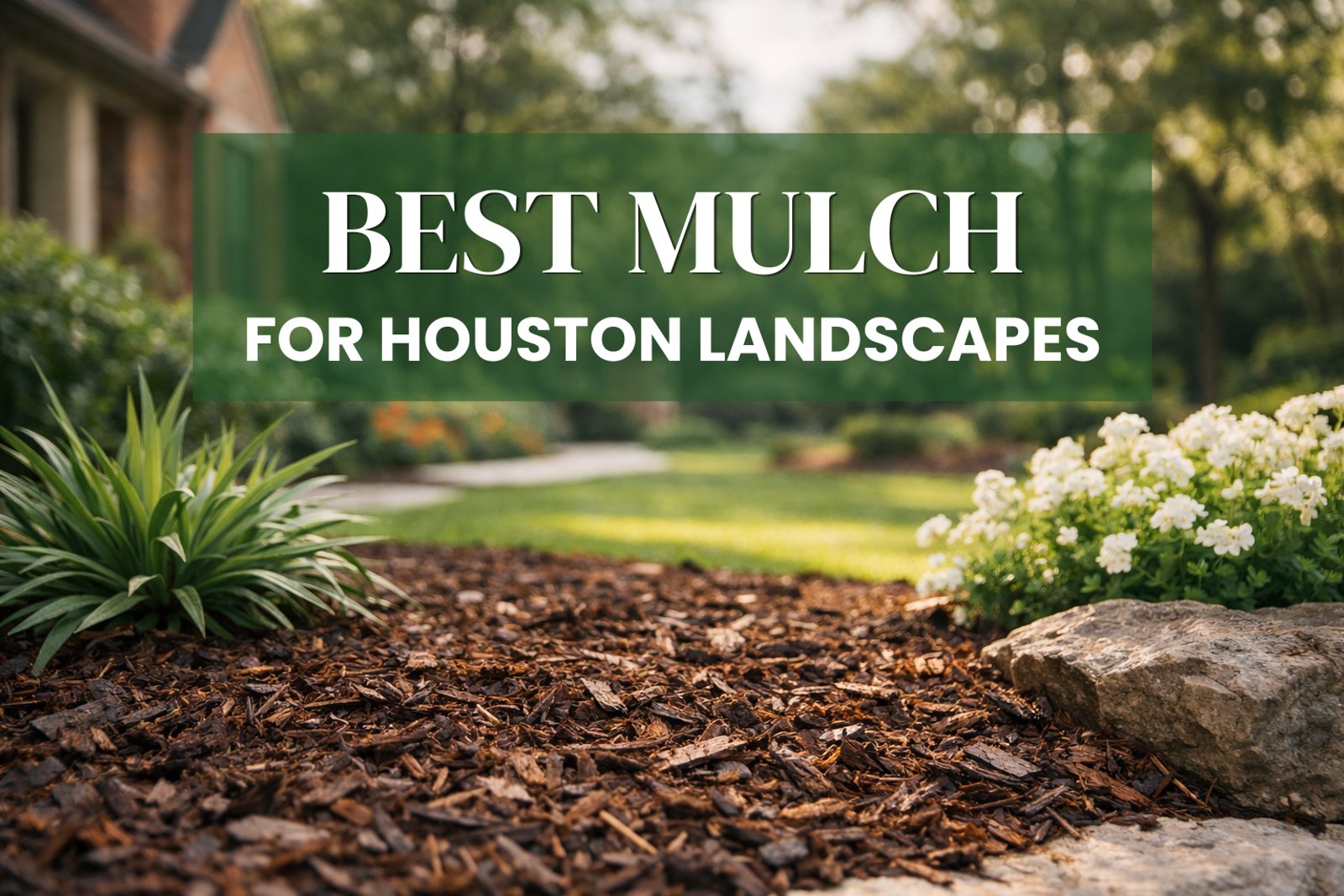
In a climate like Houston's, mulch plays a more critical role than many homeowners realize. Beyond appearance, it directly affects how well planting beds retain moisture, regulate temperature, and withstand the region's frequent swings between heat and heavy rain.
Choosing the best mulch for Houston landscapes is not simply a matter of preference. It requires selecting a material that performs consistently under demanding conditions—something not all mulches are designed to do.
Across neighborhoods such as Houston Heights, Memorial, and River Oaks, one type of mulch tends to meet those demands more reliably than others: natural shredded hardwood mulch.
Understanding Houston's Mulch Requirements
Houston's environment places unique stress on planting beds. Extended periods of heat can dry out soil quickly, while sudden downpours can displace lighter materials. At the same time, year-round weed pressure means mulch must provide consistent coverage rather than break down too quickly.
Guidance from the Texas A&M AgriLife Extension Service emphasizes that effective mulch should help regulate soil temperature, retain moisture, suppress weeds, and contribute to soil health as it decomposes.
These criteria narrow the field considerably.
Why Hardwood Mulch Performs So Consistently
Among commonly available options, shredded hardwood mulch tends to align most closely with what Houston landscapes require.
Its fibrous composition allows it to interlock as it settles, which helps it remain in place during heavy rainfall. This characteristic is particularly useful in areas with drainage challenges or slight elevation changes, which are common in parts of Memorial.
Hardwood mulch also retains moisture effectively without becoming waterlogged. In neighborhoods like Houston Heights, where planting beds are often more compact and exposed to reflected heat, that balance can make a noticeable difference in plant health.
Over time, as the material breaks down, it contributes organic matter back into the soil. This gradual improvement supports root development and helps maintain more stable growing conditions.
Equally important, hardwood mulch tends to maintain a natural, uniform appearance as it ages. In more design-focused areas such as River Oaks, that consistency often aligns better with the overall landscape than materials that fade unevenly or shift out of place.
Mulch Comparison: What Works Best in Houston
| Mulch Type | Performance in Houston | Best Use Case | Overall Recommendation |
|---|---|---|---|
| Hardwood Mulch | Excellent – resists rain, retains moisture, improves soil | All-purpose beds, front yards, large properties | Best Overall |
| Pine Bark Mulch | Good – drains well, moderate stability | Ornamental beds, decorative areas | Good Alternative |
| Cypress Mulch | Fair – can float or shift in heavy rain | Low-slope areas | Inconsistent |
| Dyed Mulch | Fair – fades in sun, varies by quality | Short-term visual impact | Not Recommended |
| Stone/Gravel | Fair – retains heat, no soil benefit | Drainage zones, modern designs | Use Selectively |
| Rubber Mulch | Poor – holds heat, no soil value | Playgrounds only | Not Recommended |
Installation Still Matters
Even the most suitable mulch will underperform if it is not installed properly.
In most Houston planting beds, a depth of approximately two to three inches is sufficient. This provides enough coverage to suppress weeds and retain moisture without restricting airflow to the soil.
It is also important to avoid piling mulch directly against tree trunks or plant stems. Proper spacing helps prevent excess moisture buildup and reduces the risk of disease.
Attention to these details is especially noticeable in high-visibility landscapes, whether in the structured front yards of River Oaks or the more compact garden beds typical of Houston Heights.
Maintenance in a Houston Landscape
Mulch is not a permanent installation. In Houston, organic materials generally benefit from periodic replenishment as they break down.
For most properties, refreshing mulch once or twice per year is sufficient. Sun exposure, irrigation, and plant density all influence how quickly material decomposes.
Because hardwood mulch breaks down at a relatively steady rate, it tends to maintain a more consistent appearance between applications compared to some alternatives.
For homeowners who prefer not to manage those details themselves, periodic professional refreshes are often scheduled alongside broader seasonal landscape maintenance to keep beds performing and looking consistent year-round.
A Practical Conclusion
There are several mulch options available to Houston homeowners, and many can be used successfully in the right context. However, when considering performance across a range of conditions—heat, rainfall, soil health, and appearance—natural shredded hardwood mulch consistently proves to be the most balanced and dependable choice.
Rather than excelling in only one area, it performs well across all of them. For that reason, it remains the material most often recommended for residential landscapes throughout Houston, from Houston Heights to Memorial and River Oaks.
For those evaluating improvements to their outdoor spaces, mulch is often one of the simplest ways to enhance both plant health and overall presentation—especially when it is selected and applied with long-term performance in mind.