
Want a Beautiful Lawn Without the Guesswork?
Spring timing in Houston is critical — applying the wrong treatment at the wrong time can cause weeds, patchy grass, or wasted money.
We offer free professional lawn evaluations to help homeowners get it right.
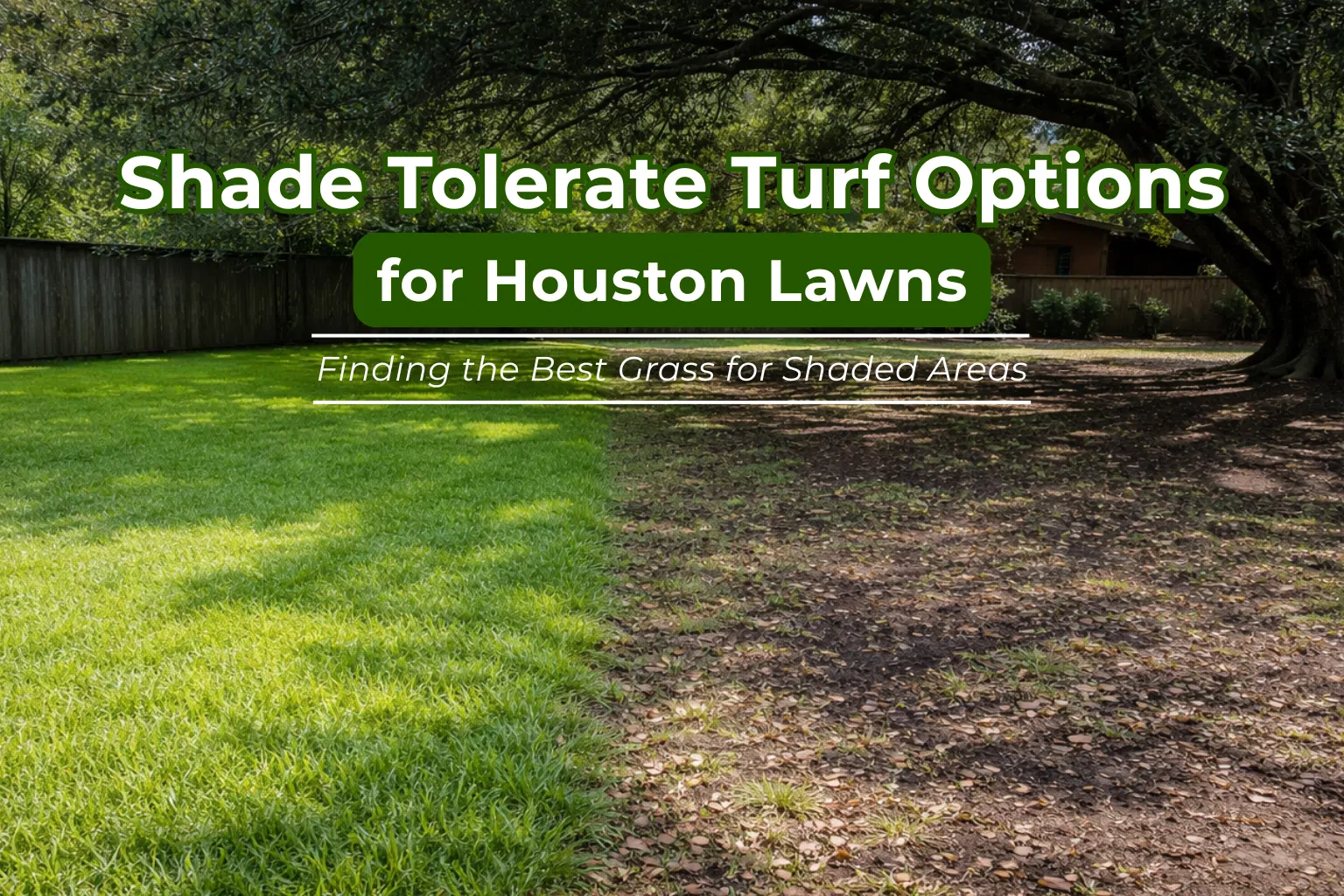
A lawn can look perfectly healthy in February, then thin out by June once the live oaks leaf out and the backyard drops into heavy afternoon shade. That’s usually when Houston homeowners start searching for the best grass for shade in Houston — and the honest answer is that no grass truly loves deep shade in our climate. Some varieties tolerate it better than others, but success depends just as much on irrigation, soil, drainage, and canopy management as it does on the grass itself.
Houston’s climate creates specific challenges: heat, humidity, heavy rainfall, compacted clay soils, and long growing seasons all put pressure on any lawn. Add filtered light or full shade, and turf has to work harder with less energy. Choosing the right shade-tolerant grass matters — but so does being realistic about how much sun your property actually receives.
How Much Shade Is Too Much for Houston Grass?
Many yards are described as shady when they’re actually getting four to six hours of filtered light. Others receive fewer than three hours of direct sun under a dense canopy — a very different situation. Turf that performs well in moderate shade may still decline in deep shade, especially when foot traffic, poor drainage, or overwatering compound the problem.
According to Texas A&M AgriLife Extension’s St. Augustinegrass management guide, even the most shade-tolerant warm-season grasses require a daily minimum of four to six hours of light to survive. If your yard consistently falls below that threshold, the better design move is often to reduce lawn area and replace it with groundcovers, beds, stone, or a more intentional shaded landscape.
That distinction matters because turf failure is often blamed on the variety when site conditions were never right to begin with. A well-designed Houston lawn starts with matching plant material to the actual light available.
For most Houston properties, the shortlist comes down to St. Augustine and select zoysia varieties. According to Texas A&M AgriLife’s turfgrass selection guide for Texas, centipede and ryegrass have limited roles in our climate and are rarely the best long-term answer for a premium residential lawn.
Best Grass for Shade in Houston: Your Top Options
For most Houston properties, the shortlist comes down to St. Augustine and select zoysia varieties. According to Texas A&M AgriLife’s turfgrass selection guide for Texas, centipede and ryegrass have limited roles in our climate and are rarely the best long-term answer for a premium residential lawn.
St. Augustine Grass — Best Overall for Houston Shade
St. Augustine remains the most popular answer for shaded lawns in Houston — and for good reason. It handles humidity well, establishes a dense canopy, and Texas A&M AgriLife Extension confirms it is the most shade-tolerant warm-season turfgrass available for Texas homeowners. If your yard has large trees and a traditional Houston landscape feel, St. Augustine is often the most natural fit.
Among available cultivars, Palmetto, CitraBlue, Raleigh, and ProVista are frequently recommended, though each comes with trade-offs.
Palmetto is known for better shade tolerance and a softer texture.
CitraBlue offers improved color and density with solid shade performance.
Raleigh has been widely used across Texas but can struggle with disease under stress.
ProVista is a newer option worth considering if reduced mowing is a priority — it grows significantly slower than standard varieties and has improved weed resistance, making it lower-maintenance overall; its shade tolerance is comparable to Palmetto, though it’s less widely available from Houston-area sod farms. Newer selections may offer improved color or density, but all still need adequate light and attentive care.
The trade-off with St. Augustine is that, while it tolerates shade better than most alternatives, it can be more vulnerable to fungal issues, chinch bugs, and overwatering in Houston’s humid climate. The Harris County AgriLife Extension office offers locally-specific resources on managing these common St. Augustine problems, including take-all root rot and chinch bug control. In lower-light areas, growth slows — meaning damaged patches recover more gradually.

Zoysia Grass — Best for a Refined, Manicured Look
Zoysia is the other serious contender when homeowners want a refined appearance with better wear tolerance. Fine-textured varieties like Zeon or Emerald zoysia can perform well in partial shade while delivering a more tailored, upscale look than standard St. Augustine. Texas A&M notes that Zoysia matrella types — which include Zeon and Emerald — tend to have finer leaf texture and better shade tolerance than coarser Z. japonica varieties.
Zoysia grows more slowly, which many homeowners appreciate for its reduced mowing demands. That same trait, however, means it takes longer to establish and repair. It also tends to cost more to install, and not every zoysia variety handles shade equally — cultivar selection matters.
For Houston properties with moderate shade, disciplined maintenance, and a goal of a polished finish, zoysia can be an excellent choice. In heavily shaded backyards, it may still thin out if light levels are too low.

St. Augustine vs. Zoysia: Which Is Right for Your Houston Yard?
St. Augustine | Zoysia | |
|---|---|---|
Shade tolerance | Moderate to good | Moderatre |
Texture | Coarse, lush | Fine, manicured |
Establishment | Faster | Slower |
Cost | Lower | Higher |
St. Augustine is generally the safer choice for shadier residential lots with mature trees. It gives a lush, familiar Houston look and handles lower light better overall. Zoysia is ideal when the yard gets moderate shade rather than deep shade, and when the goal is a finer, more manicured lawn texture.
There’s also a design question. A front yard that needs strong curb appeal may benefit from one turf choice, while a backyard organized around entertaining, pets, or kids may call for another. The best lawn isn’t just the one that survives shade — it’s the one that fits how the property is used.
Why Shaded Lawns Fail Even With the Right Turf
Homeowners are often advised to swap grass varieties, but the grass itself is only part of the equation. In shaded settings, turf has fewer resources to recover from stress. A few avoidable maintenance habits can push it over the edge.
Mowing too low is a common problem. Shaded grass needs more leaf surface to capture light, so scalping makes it even more vulnerable. Overwatering is another issue — especially in Houston’s clay soils, where water can linger for extended periods. As noted by Texas A&M AgriLife Extension, damp, low-light conditions are ideal for take-all root rot and other fungal disease, which are among the most common causes of St. Augustine decline in the Houston area.
Tree root competition matters too. Large roots absorb moisture and nutrients, while dense canopies block airflow and sunlight simultaneously. That combination leaves turf thin, patchy, and prone to fungal problems. Selective canopy thinning can dramatically improve lawn performance. Sometimes, though, the shade is simply too heavy — and no turf choice will produce the result you want.
It’s also worth noting that shaded lawns require a different fertilization approach. According to research from Texas A&M AgriLife, shaded turf needs only about half to two-thirds the nitrogen of a full-sun lawn — over-fertilizing in shaded conditions can actually increase disease pressure rather than improve growth.
When Grass Isn't the Right Answer
One of the most valuable conversations in landscape design is recognizing when to stop fighting the site. If a space under mature oaks gets only a few hours of broken light, replacing failing turf with a shaded garden composition is often more beautiful and more durable than repeated sod replacement.
Options include defined planting beds, low-maintenance groundcovers, gravel pathways, or a patio extension that makes the space more functional. On higher-end Houston properties, this approach often feels more intentional than patching weak lawn year after year. It also protects the health of mature trees by reducing soil disturbance and unnecessary inputs.
Installation and Maintenance Tips for Shade-Tolerant Turf in Houston
Even the best turf choice can underperform if installation is rushed. Houston’s heavy clay soil is notorious for poor drainage and compaction — addressing grading and drainage before laying sod is essential. Fresh sod over hard, uneven ground rarely develops the deep rooting needed to handle our summer stress. If you’re unsure of your soil’s composition or pH, the Harris County AgriLife Extension office offers soil testing resources and locally-tailored guidance.
Once installed, follow these care guidelines for shaded turf:
- Mow higher than you would for sun-grown turf to maximize light capture
- Water deliberately, not automatically — overwatering in low-light areas invites disease
- Fertilize conservatively at roughly half the rate you’d use in full sun
- Be patient with appearance — shaded lawns naturally look softer and less dense than full-sun turf, and that’s normal
Get a Professional Assessment for Your Houston Lawn
Not sure which shade-tolerant grass is right for your property? The answer often depends on more than just the variety — it involves canopy coverage, drainage patterns, soil health, and how you use your outdoor space.
We help Houston homeowners find the right balance of turf, beds, and hardscape so every part of the property looks intentional and performs well — even under heavy tree cover.
A shaded Houston yard can still feel lush, clean, and beautifully finished. The key is choosing turf that matches the light you actually have, then giving it a setting where it has a fair chance to succeed.

Need help maintaining your lawn?
Let Strong Landscaping Handle It For You
- No Obligation
- 45-60 mins
- On-site at your home
Our professional lawn care services include:
Spring fertilization programs
Weed prevention and control
Expert mowing and maintenance
Irrigation inspections
Seasonal lawn health assessments


